




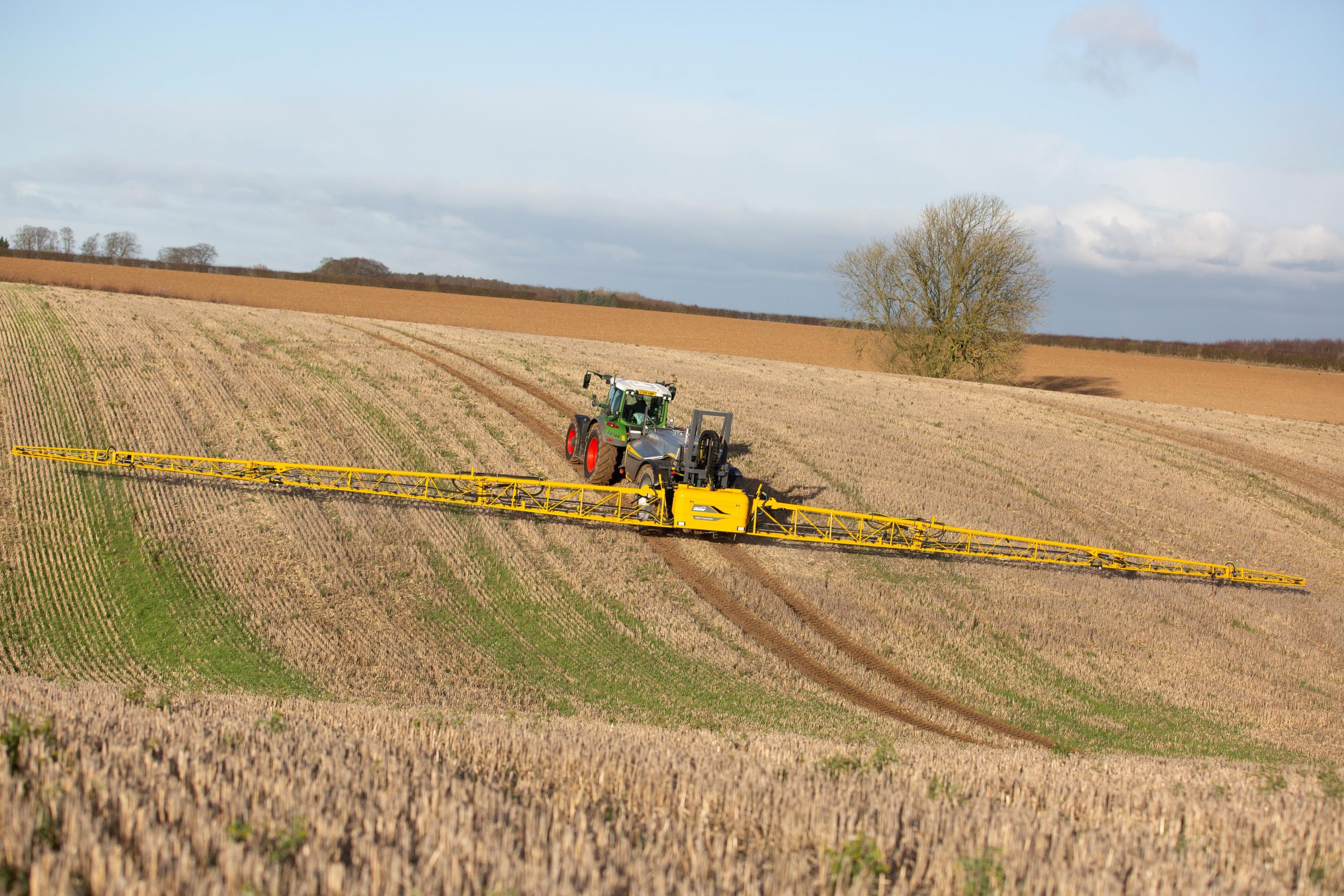
Increasing spraying capacity while taking advantage of the latest technology to boost accuracy and make for easier application have been the main benefits enjoyed by HA Harris Farms from the purchase of a Chafer Sentry trailed sprayer. But the Sherborne, Dorset business has also appreciated the excellent back-up offered by application specialists Chafer and their dealer Redlynch while getting to know the new machine.
“We had some issues with parts and service on a previous sprayer and were nervous of the challenges of a new machine, to the extent that we requested an extended warranty,” admits Tim Harris, “But thanks to the help from Chafer’s Ben Bryant who set up the machine, trained us and continues to offer support and Steve Blunden from Redlynch, our first season with the Chafer Sentry has gone very smoothly.”
HA Harris Farms had made the decision to trade up from a 3200 litre, 24m trailed machine to a 5000 litre, 30m Chafer Sentry, and took delivery of the new sprayer in February. “We have 510ha to spray in four locations, including contract work,” Mr Harris explains. “Winter wheat is the main crop, plus oilseed rape, spring wheat, spring barley and spring beans, and 60ha of maize, and the soils are variable from stone brash to heavy clay. While the terrain is mainly flat, there is one hilly area on a medium clay loam, and the land can get very wet.”
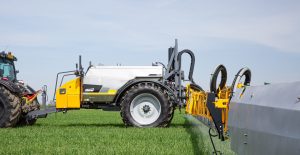
Matching to the farm’s 5000 litre bowser was the main reason for the jump in tank capacity, he comments. “The bowser means that we can travel to outlying farms and be independent and had already increased output; but with 5000 litres capacity on the sprayer, a large field can be completed with one fill at the optimum water rate, without sending a bowser. “Weight can be an issue in some places, but we don’t have to run the sprayer full if the conditions don’t suit – putting in half, a third or a quarter of a load reduces weight so that we can get on.” Operator Jerry Babey adds that the Sentry’s clever tank design means that it is wide rather than tall to offer the extra capacity, so remains stable on the road and on sloping land.
Boom width also went up, to 30m, to fit in with the 6m drill and 10m combine header. “It seemed like the natural size and with RTK on all the machines we can match up the tramlines so they are easier to manage. We also specified folding to 24m for those farms that are still on narrower tramlines,” explains Mr Harris. “It has definitely increased capacity, although the number of small fields means a lot of folding and unfolding so we don’t achieve the workrates that some operations might – we would average 220ha/day.’
Boom control technology was also an important aspect of the brief, with the G-Series tri-fold boom chosen, equipped with Chafer’s Contour boom levelling system. A new feature for the farm is sub-zero geometry, offering the ability to dip below the horizontal when spraying along the top of a hill; Mr Harris comments that the boom is very stable, allowing forward speed to be consistent for accuracy.
GPS auto-shut off offers 13 sections of varying width, which can be shut off on angled headlands and to avoid overlaps. “In addition to the greater accuracy, auto shut-off also reduces operator fatigue and allows you to concentrate on spraying. Over an intensive few days’ spraying, you really notice the difference,” says Mr Harris, adding that even if the RTK signal goes down, he can switch back to 30cm accuracy and it is still an improvement over the previous system. “We were keen to increase accuracy, and this system also uses air shut-off so it’s a more instant reaction – it’s a good feature.”
Boom lights have also been specified and Mr Babey comments that they provide an excellent view of the nozzles when working at night; there is also the option to extend the boom to 36m in the future if required.
Manual valves were chosen over an electronic system for simplicity, and Mr Harris says that with Chafer’s intuitive layout, hydraulically driven pump and user-friendly induction hopper, filling is quick and easy. “You can put a five-way T1 mix in without needing to shut off the water, and we also find the washout procedure effective and straightforward.”
With the extra weight in mind, larger wheels have been specified, with 420 tyres on the narrow wheels and 650 for reduced ground pressure work. The Sentry also has a steering axle, which Mr Babey comments makes for easier turning in gateways, compared to a steering chassis on its predecessor, which only worked with the booms out.
Control is via a Muller 800 Touch screen, an option which allows Mr Harris to record applications with a high level of accuracy, documenting precisely when a particular part of the field was sprayed and with what. “It’s taken a bit of getting used to as we’ve previously had Trimble controllers. But it was well worth specifying a more sophisticated system which links to the farm office PC, allowing me to upload the fields so Jerry can go into the screen and get the recommendation.”
“We can document applications showing sensitive areas such as rivers or footpaths, or highlight tramlines where we have trialled a particular treatment, and then overlay that detail on a yield map – it’s a management tool.” He adds that the touch screen is clear and intuitive and the joystick offers multiple functions. “We can also easily swap it between our two tractors, for example if one is on narrow tyres in the spring.”
Mr Harris comments that while they had specific requirements for the sprayer and the specification took some time to put together, Chafer has been unwavering in its commitment to build a sprayer to meet their needs.